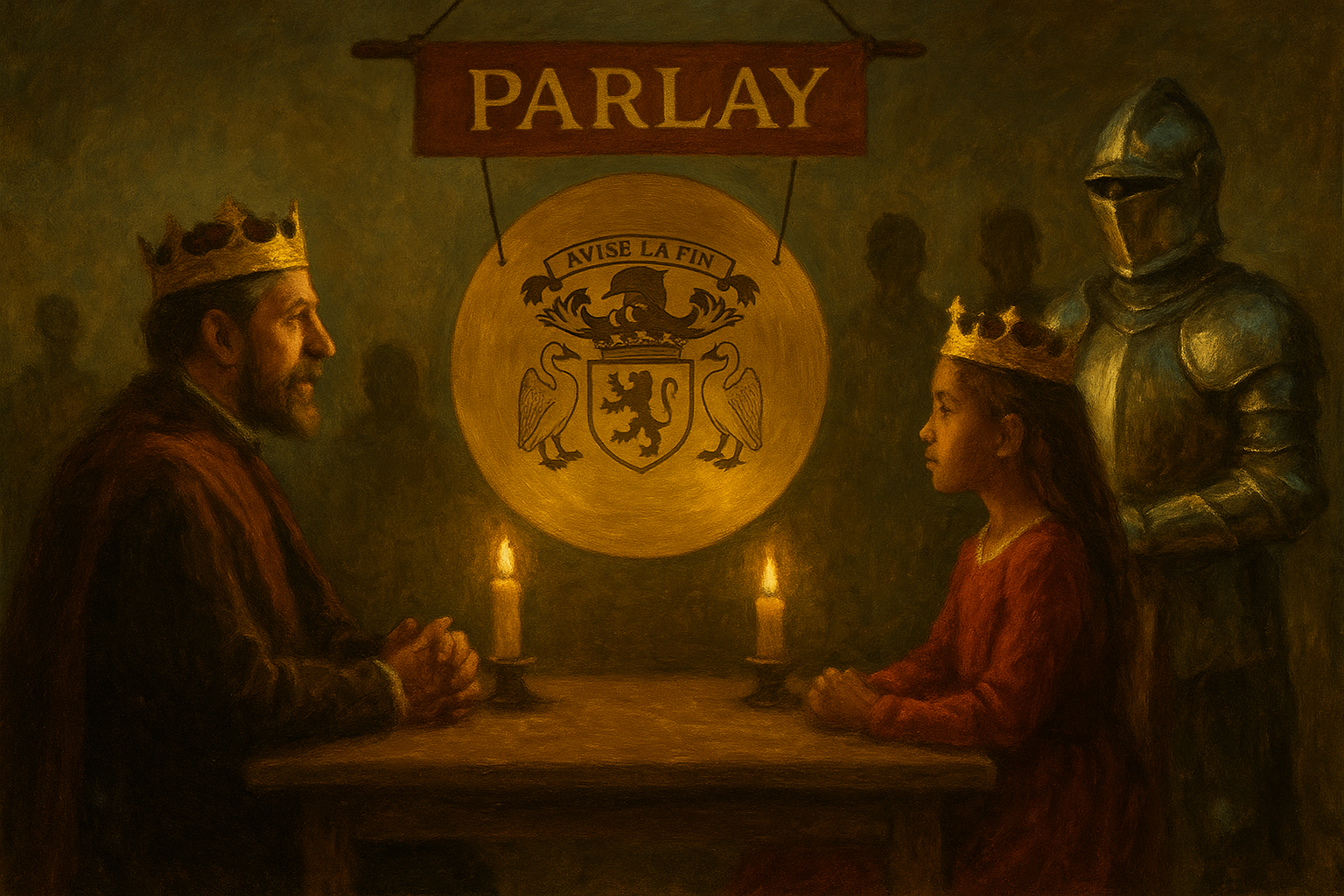
Origin Note: Parlay as Protected Audience
Historically, “parlay” carried the idea of temporary protection so a captured party could speak to authority without harm.
That concept translates cleanly into a home: emotional force is suspended long enough for truth to be spoken, heard,
and concluded with clarity.
Parlay does not guarantee agreement. It guarantees dignity, hearing, and a governed process.
Article I — Invocation
Parlay may be invoked by either party when normal communication is strained and the temperature in the room is rising.
Parlay is not used for ordinary conversation. It is used when escalation is beginning.
Meaning
Parlay is the emergency brake — not the steering wheel. If you call it for everything, it loses power.
If you only call it after the explosion, it comes too late.
Article II — The Gong and the Hour
Invocation begins a one-hour preparation period from the Parlay gong. The hour is for cooling down and preparing.
No verdicts are rendered while flooded.
Meaning
Pilots don’t wait for the engine to quit before practicing procedures. Families shouldn’t wait for escalation
before rehearsing how they’ll handle conflict. The hour is the runway: it returns oxygen to the brain.
Article III — Proper Attire
Participants arrive in proper attire chosen by the family (Sunday best or equivalent). Attire signals seriousness,
self-respect, and intentionality. Parlay does not begin until both parties are prepared.
Meaning
This is not about vanity. It’s about state change. If one person shows up in full seriousness and the other shows up casual,
credibility drops. Dressing is “skin in the game.” It trains the body to treat the ritual as real.
Article IV — Crowns Removed
At the table, crowns (or symbols of rank) are removed and placed on the table.
This symbolizes equal dignity even when authority is not equal.
Meaning
Authority remains. Dignity is equal. The ritual teaches something rare: the parent can hold the boundary without humiliating
the person. Power stays clean when it is governed.
Article V — Guarantees of Parlay
Parlay guarantees:
- A cool-down window before decisions.
- A promise to be heard (not necessarily agreed with).
- The right to a Second (advisor) if desired.
- Witnesses / a record when truth is disputed.
- Perspective-taking: each must accurately summarize the other before responding.
Meaning
This is what separates Parlay from “communicate better.” It is ritualized governance: a container that lowers threat,
protects dignity, and makes truth possible when emotions are loud.
Article VI — The Second
A Second is allowed to assist in preparation, help a participant find words, and help preserve the structure.
The Second may not speak for the person, dominate, or prosecute the other party.
Meaning
The Second exists to prevent collapse into panic or silence. They help the child show up well — including explaining
why proper attire matters: if you don’t respect yourself enough to prepare, your words will not carry weight.
Article VII — Damage vs Breach
Parlay separates material damage from breach of rule.
- Damage: what must be restored physically (mess, cost, time, repairs).
- Breach: the disrespect of the boundary itself (known rule ignored).
Repair must address both when both exist.
Meaning
If there was no rule, cleaning the mess may be enough. But when a rule exists, the deeper repair is relational:
trust, restraint, and respect for the boundary. That’s not ego — that’s governance.
Moral Math: “What Did This Cost?”
Parlay is not designed to make a child hurt. It is designed to make them calculate: time, effort, risk, trust, and consequence.
External fines produce compliance. Internal accounting produces ownership — and ownership produces leadership.
Parlay Decision Worksheet (Short-Term / Long-Term)
| Option |
Pros (short-term) |
Cons (short-term) |
Long-term outcome (“the End”) |
Option A
What are we choosing? |
… |
… |
Who does this shape me to become? |
| Option B |
… |
… |
What does this build or break over time? |
| Option C |
… |
… |
What does “future me” pay for this? |
Use this verbally with young children. Write it with teens. The point is repetition: ritual > improvisation.
Article VIII — Self-Imposed Correction and Mercy
The ideal outcome is the child proposing a valid self-imposed correction. If accepted, agency is returned.
Authority may commute a sentence as mercy when restoration is complete or when the child over-punishes.
Meaning
This removes the parent from being “the bad guy” and turns discipline into leadership formation.
Mercy must flow downward in hierarchy — not self-discounting, but commutation by authority.
Article IX — Participation vs Belonging
Belonging is not conditional. Participation in privilege may be restricted until restoration begins.
The pathway back is always available: choose reflection, propose restoration, and repair.
Meaning
This avoids punishing siblings for one person’s refusal, and avoids “banishment.”
The message is: you are always family — and joy flows from restored order.
Article X — Privacy Pause
If a topic becomes sensitive, intimate, or dignity-threatening, a pause may be called to continue privately
with the necessary parties only.
Meaning
Parlay is never a stage for embarrassment. The ritual exists to protect dignity.
Privacy is a safeguard — not an escape.
Article XI — Refusal
If a participant refuses Parlay structure (no preparation, no listening, no perspective), Parlay is suspended.
Standard household consequences apply, and privileges may pause until a governed conversation is chosen.
Meaning
This is the moment where a person is choosing distance from restoration. The door remains open.
The consequence is not revenge — it’s the cost of refusing governed order.
Example A — Real World: Late Coming Home, No Call
This is not a fictional scenario. The phone died — but the responsibility still existed:
call before leaving, or communicate the moment delay begins. The risk is not “rule breaking.”
The risk is panic, uncertainty, and safety.
Parent
“The decision isn’t whether you’re ‘in trouble.’ The decision is how we restore trust after you were very late with no call.”
Parent
“Pros of not calling: you avoided an awkward moment. Cons: we didn’t know where you were. If we panic, we call police. That escalates fast.”
Parent
“Tell me what you think a fair restoration looks like — both for the worry and for the boundary.”
Adult Child
“A week of extra chores.”
Parent
“That’s ownership. I accept it. And after restoration begins, we’ll decide what mercy looks like.”
The lesson is not fear. The lesson is internal governance: “I make the best decision I can with the information I have,
and I own the outcome.”
Example B — Teen Scenario: Sneaking Out / Sneaking Back In
Parlay here is not about domination. It’s about safety and trust. The central questions are:
Why the secrecy? What was avoided? What risks were created? What do we do differently next time?
Parent
“Parlay. Gong. One hour.”
Parent
“The decision is how we handle safety and trust after you left without telling us.”
Parent
“Why did you feel you had to sneak out instead of ask? Were you avoiding a ‘no’? avoiding disappointment? avoiding accountability?”
Parent
“Pros: you felt free. Cons: nobody knew where you were. If something goes wrong, we don’t even know where to start.”
Parent
“Now perspective: summarize what you think we experienced tonight — before you defend yourself.”
Teen
“You were scared… and probably angry… and didn’t know where I was.”
Parent
“Correct. Now propose restoration. And propose a prevention plan: how do we avoid this next time?”
Safety note: if the parent pays for a phone, location tools may be part of a safety plan — explained openly as emergency support,
not everyday surveillance.
Closing: The Matter is Settled
Parlay ends cleanly. No re-litigation. No passive-aggressive callbacks. If further work is needed, a new Parlay is invoked later.
Parlay exists so the house does not drift into chaos — and so the child learns what kind of leader they wish to become.
“The matter is settled.”
Crowns restored.
A handshake, hug, fist-bump, or nod may be offered — never forced. Boundaries are respected.
Before You Rise from the Table
Parlay is not only for moments of conflict. It is training for decision-making long before
the heat rises.
The goal is not to win arguments. The goal is to build leaders who govern themselves.
Use the tools you have been given:
- Weigh the pros and cons honestly.
- Ask what the long-term cost will be.
- Consider who this choice shapes you to become.
And as alway...
Seen in the Realm:
These ideas are reflected in the stories of Glimmerglass.
Step back into Glimmerglass Lore →