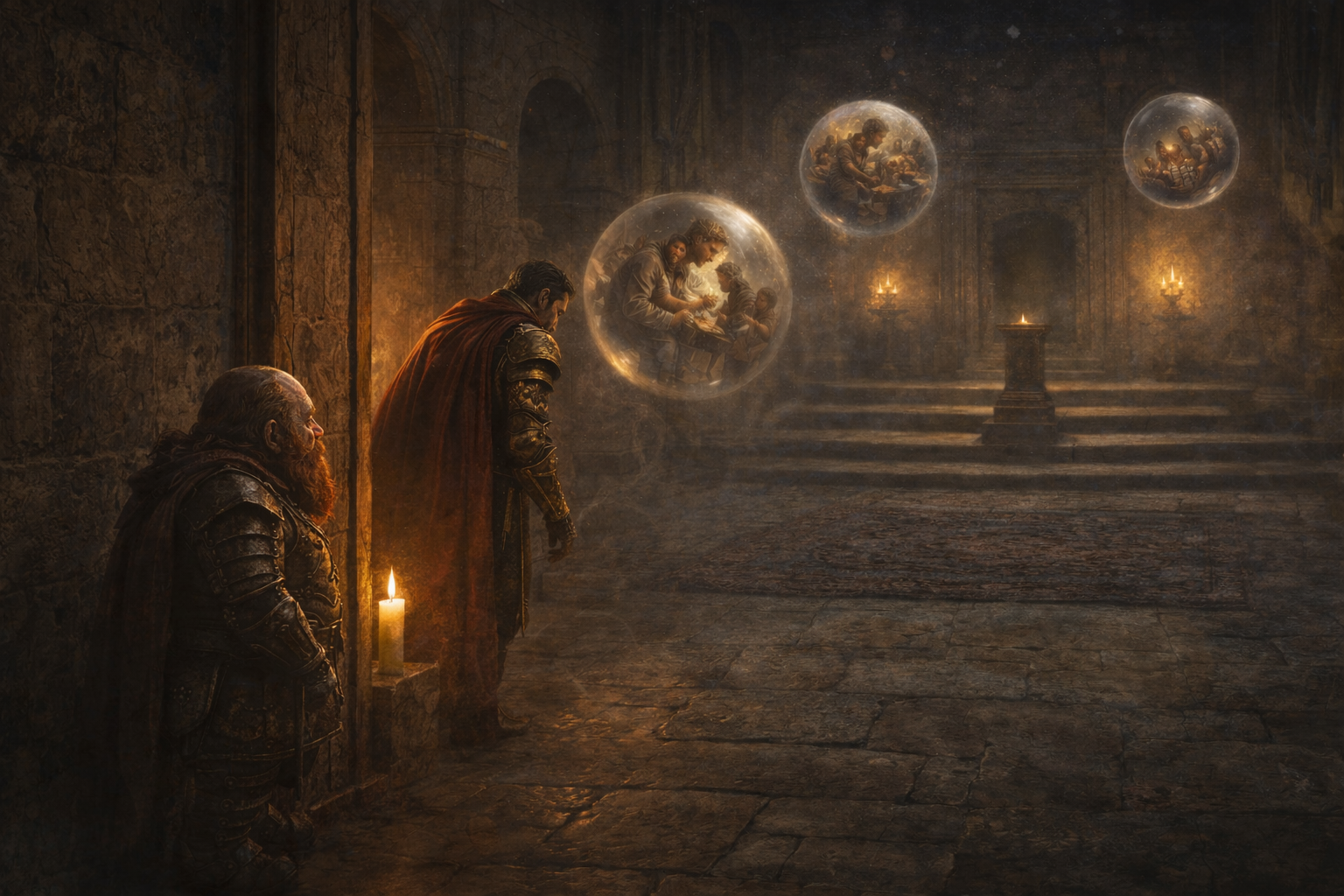
A humane, proportional “pause in proceedings” designed for internal consequence — the kind that reforms character instead of merely enforcing compliance.
The Reflection Room is a governed space — not a punishment chamber. It is distance with purpose: a structured pause where heat can cool and truth can be found without humiliation.
In our fictional realm, the Room has doors and thresholds. In real life it may be as simple as time in a bedroom, a quiet chair, or a walk with no debate. The principle remains the same: pause first, judge later.
The Room does not punish. It does not argue. It does not try to beat you.
It reflects.
It offers perspective from the outside looking in — allowing you to see your tone, your posture, and the weight of your words as others experienced them.
If the Room only showed what was wrong, no leader would return to it often. Shame breeds avoidance.
The Room shows both:
It does not invent virtue or expose monsters. It reveals trajectory.
In a fire, heat rises. Those who survive stay low.
Humility is low to the ground. It has little distance to fall.
But the one who places himself high — on a pedestal above correction — feels the heat first. The higher we elevate ourselves, the harder the fall and the more work required to come down.
At the far end of the Reflection Room there is another door.
It is not locked. It is not barred. If the images become unbearable — if the truth feels too sharp — a person may choose to leave.
No decree is spoken. No guard escorts you out. You simply step away from the work.
Outside the Room, life continues — but differently. Fellowship cools. Trust narrows. Influence diminishes. Not as punishment, but as consequence. Avoided reflection does not disappear. It waits.
I am not against authority. I am against bad authority.
Good authority protects the humble and maintains order. Bad authority protects itself, exempts itself, and uses power to avoid correction.
A leader who cannot be examined will eventually be feared or ignored. A leader who can be corrected builds a culture that lasts beyond his lifetime.
When a parent takes seriously his role as leader, he becomes more aware that inconsistency speaks loudly — even in small things.
Breaking traffic laws while demanding obedience at home screams contradiction to a child who is looking for alignment. Children are not confused by complexity. They are confused by hypocrisy.
Humility is the best response. When caught, do not defend reflexively.
The side of the road is not the place to litigate. Process exists for a reason. Restraint in the moment is strength.
The Reflection Room does not replace Parlay — it protects it. Parlay exists to clarify truth, not force confession.
A child who refuses to admit wrong may be prideful… or may be innocent. A just system must leave room for both possibilities.
The goal is real rehabilitation — doing the internal work to become a better human being and return governed.
In the home, this may look like time in a room or a quiet corner. Release is not merely timed. It is conditional upon a posture capable of restoration.
When repair is made and posture is governed, fellowship should be restored visibly.
Use the tools you have been given.
The goal is not to win arguments. The goal is to build leaders who govern themselves.